Compute > Cloud Functions > Overview
Users can write codes by function unit. Functions defined on a specific event are automatically executed, processing the required tasks. Without server management or infrastructure configuration, you can focus only on application logic.
Features
- Cost-effectiveness
- Save money with pay-as-you-go pricing.
- You can reduce management cost as it allocates resources only when necessary.
- Scale up and down automatically on demand to keep operating efficiently.
- Rapid development and deployment
- Focus on the core business logic.
- Shorten the development speed by reducing the burden of DevOps operation.
- Flexibility and scalability
- Support for multiple languages and runtimes.
- The event-based architecture is versatile.
Main Features
- We offer multiple languages (environments).
- The code editor makes you write simple function unit code.
- Provide an HTTPS Endpoint as standard to perform the function.
- Iterate the function at regular cycles.
Two Modes Available
Pool Manager
- Instances are created and use resources only when the function is performed.
- If the function is not performed for a certain period, instances disappear, and the resource usage becomes 0.
- Use it only when the number of requests is small to perform the function and event occurs.
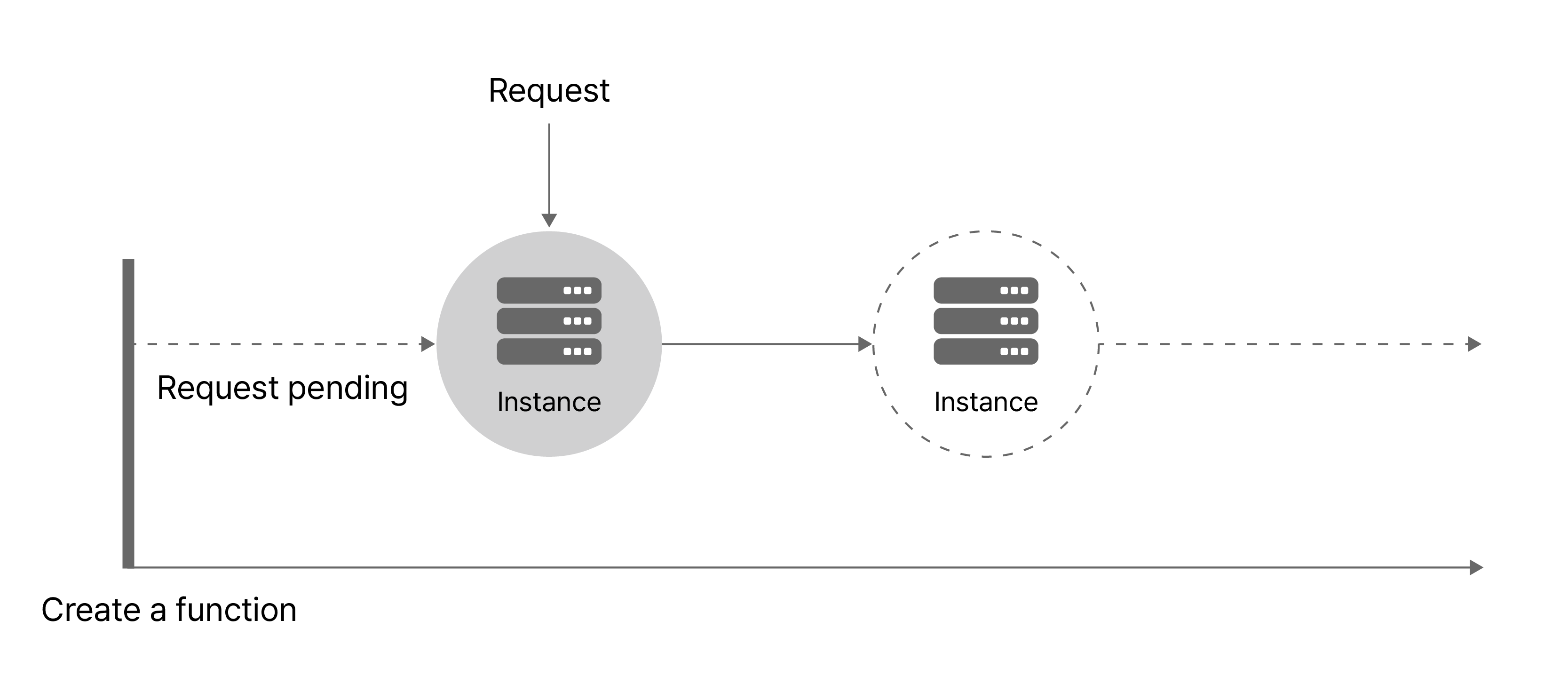
New Deployment
- Once functions are created, instances are created, keeping a certain amount of resources being used.
- Instances are kept to reduce response latency.
- Use it when the number of requests is large to perform the function and a quick response is needed.
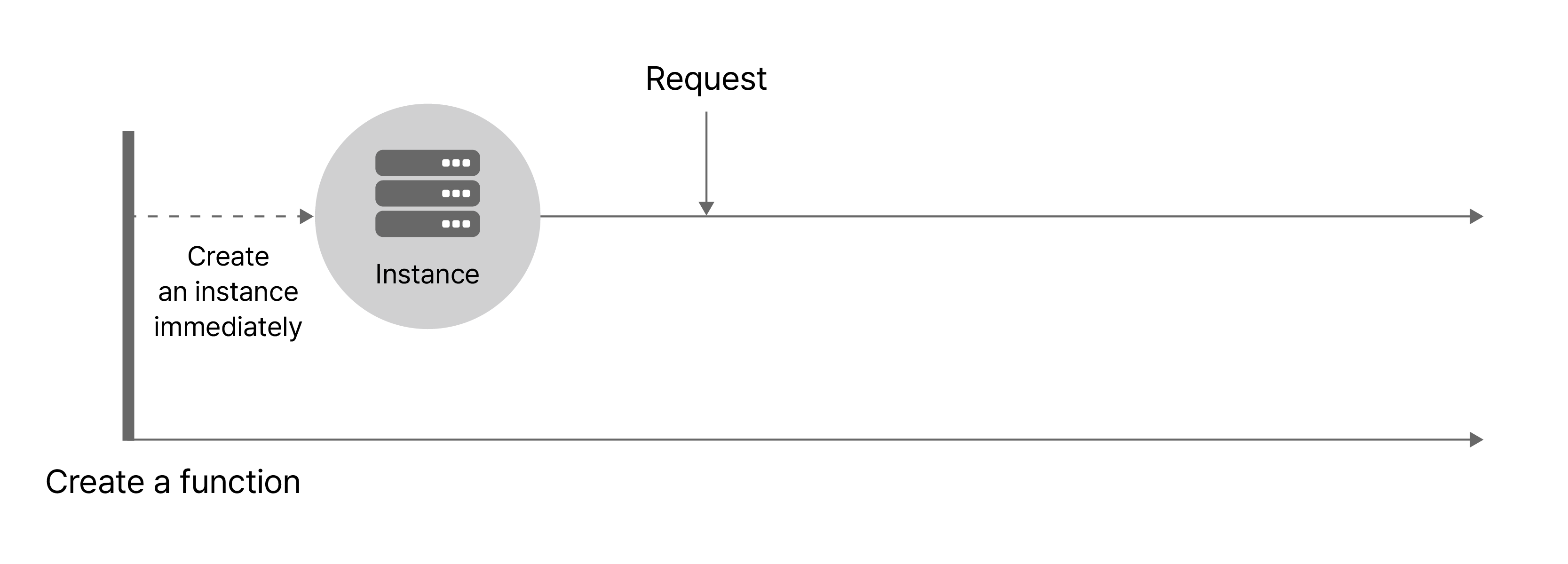
Supported Languages
| Language | Version | End of Support | End of Service |
|---|---|---|---|
| NodeJS | 22.5.0 | 2027-04-30 | 2027-10-30 |
| 20.16.0 | 2026-04-30 | 2026-10-30 | |
| Debian(20.16.0) | 2026-04-30 | 2026-10-30 | |
| Python | 3.13 | 2029-10-10 | 2030-04-10 |
| 3.12 | 2028-10-02 | 2029-04-02 | |
| 3.11 | 2027-10-24 | 2028-04-24 | |
| Go | 1.25 | - | - |
| 1.24 | - | - | |
| 1.23 | 2026-02-21 | 2026-08-21 | |
| 1.22 | 2026-01-28 | 2026-07-28 | |
| Java | 21 | 2029-12-31 | 2030-12-31 |
| 17 | 2027-10-31 | 2028-10-31 | |
| Ruby | 3.4.5 | 2028-03-31 | 2028-09-30 |
| 2.6.1 (end of service) | 2024-01-30 | 2025-01-30 | |
| .NET | 8 | 2026-11-10 | 2027-11-10 |
| 7 (end of service) | 2024-05-14 | 2025-05-14 |
Runtime Support Status
Each runtime is categorized into one of the following three statuses based on the EOL (end of life) policy.
| Status | Description | Create function | Modify function |
|---|---|---|---|
| Active | The runtime is fully supported. | Available | Available |
| Deprecated | The runtime community support has ended after the deprecation date. There are no restrictions on use, but migration to the latest runtime is recommended. | Available | Available |
| Discontinued | The discontinuation date has passed. Function execution is not forcibly stopped, but normal operation is not guaranteed, and new creation and modification are restricted. | Unavailable (excluded from list) | Unavailable (modify button disabled) |
- Deprecation date: The runtime enters the "Deprecated" status from this date.
- Discontinuation date: The runtime enters the "Discontinued" status from this date.
The status of a runtime can be checked in the function list, function details, and the function creation/modification screen. For details on behavior, see the console user guide.
Trigger
- HTTP Trigger
- Basic (support GET, POST)
- Timer Trigger
- You can add it in the cron expression form.
- API Gateway Trigger
- It can be integrated with the API Gateway service.